Showing posts with label TCM. Show all posts

Sunday, November 6, 2011

The Thin Man


Has there ever been a detective movie more sophisticated, swift, charming, breezy, fun and less interested in the crime than the The Thin Man?  As Nick and Nora Charles, William Powell and Myrna Loy (along with the dog Skippy playing Asta) created two of the most iconic characters of the early years of sound.  Witty, bantering, smooth, rich, the Charles are unique in Hollywood as a couple that actually enjoys being married.  

A mega hit from 1934, The Thin Man is based on the book by Dashiell Hammett.  MGM bought the rights to the book for $14,000 and then relegated the production to B movie status.  

However, after Louis B. Mayer tapped W.S. Van Dyke to direct, Van Dyke in a moment of genius, cast Powell and Loy as the disinterested sleuths, Nick and Nora Charles.  At first, Powell at 41 was considered too old for the role, and Loy usually was cast as the femme fatale.  However, Powell and Loy had just shot Manhattan Melodrama with Van Dyke and Clark Gable, and Van Dyke insisted on making the movie with the two stars.  Fortunately, Mayer relented.

The movie was shot over twelve days for the small amount of $231,000.  Eventually, the movie made $1.4 million in it's initial run, a giant hit for the time.  

Powell became one of the biggest movie stars of the 30s and Loy was reinvented as the witty, professional, urbane perfect wife.  The movie became the symbol for Hollywood escapist fun during the early days of the depression.  A good looking, fun couple, spending money, going to parties in New York City, laughing at each other, and maybe solving a crime. 

Hammett first claimed that the banter was based on his relationship with the playwright Lillian Hellman.  Then, the screenwriters Albert Hackett and Frances Goodrich said that the dialogue was based on their relationship. 

Yet, to anyone watching the movie, the source of the dialogue is less important than the chemistry between Powell and Loy.  Their ease and comfort with each other comes across as effortless fun, a treat to watch.

The pairing of the two actors was so successful that they starred in fourteen movies together, including five more Thin Man movies.

Oh, and then there's the plot.  Nick Charles is a retired private investigator who lives with his wife in San Francisco managing her families investments.  The Charles are visiting New York City during the Christmas holidays.  A former client of Nick's, Clyde Wynant, has gone missing and the Wynant's, their lawyer, and the police all believe that Nick will solve the case.  Some people die, but mostly Nick and Nora drink. 

A lost fact in all the success of the movie is that the title actually refers to Clyde Wynant, not to Nick Charles.  Plus, to add to the confusion, most of the paperbacks of the The Thin Man are published with a dapper looking Dashiell Hammett on the cover.  However, Powell's characterization of Nick Charles is so extraordinary that it ended up embodying everything Thin Man forcing all subsequent sequels to have the name Thin Man in the title.  The Thin Man is a state of mind, a level of coolness, suaveness, dapperness, unflappability, swing jazz and the perfect martini. 

The other less talked about but equally as crucial piece of casting by Van Dyke is that of Skippy to play the dog Asta.  Originally, Asta in the book is a female schnauzer.  Skippy is a male wired-hair fox terrier.  If Nick and Nora is the couple ever wants to be, then Asta is the best friend that everyone wants.  Especially since Asta never interferes with the Charles' banter, he's the perfect companion.  He tugs them around town, hides from danger, and does a bit of detective work on his own.  After the success of the movie, the interest in terriers as a pet skyrocketed.  

My family's love for the Thin Man movies was such that we, also, had a wired hair fox terrier, Casey.  Casey was my high school and college dog.  He had more energy and personality than I thought possible from dogs.  Aggressive, funny, proud, cocky and at times obnoxious (if that's possible from dogs), he would drag my parents around the neighborhood chasing after birds and rabbits.  When they visited me in college, Casey would drag my parents through Colonial Williamsburg, and chased one girl living in my dorm, up, over a couch and into the arms of one of my friends..  I almost felt bad, but I couldn't stop laughing.  Casey might not have solved crimes, but he was the perfect companion for me. 

The Thin Man was nominated for four Oscars:  William Powell for best actor, Van Dyke for director, best screenplay, and best movie.  The movie didn't win any awards, but it's energy is still infectious.  A young Maureen O'Sullivan, the former wrestler Nat Pendleton and a very young and dapper Cesar Romero also star.  Skippy went on to have one of the great movie careers for animals.  He also starred in The Awful Truth as Mister Smith with Cary Grant and Bringing Up Baby as George, again with Cary Grant.  That dog was in three classics......

Saturday, October 29, 2011

Limelight


October is Buster Keaton month on Turner Classic Movies.

My DVR is full of Keaton's silent shorts and feature lengths.

Tonight I watched Charlie Chaplin's Limelight, which guest stars Buster Keaton.

A very strange movie. The story is about an aging performer coming to terms with his declining abilities, told by a filmmaker whose abilities were noticeably declining.

Chaplin plays an older stage clown who tries to mentor a young ballerina. At times, the movie is almost unwatchable. The female character bounces between hysterics and a mysterious inexplicable paralysis. Ultimately, she ends up being a sounding board for Chaplin's gripes about getting older, his frustrations with a changing audience, and even working out his issues with women. There's actually a scene where you begin to wonder if he's in character yelling at Claire Bloom, or if he's in therapy working through his complicated relationship with his mother, who was mentally ill.

When Chaplin's character wasn't being preachy the movie fell into a spine tingling level of schmaltz. As Chaplin aged, his movies bent more towards maudlinism. In The Great Dictator, he walked a very tight, brilliant line between comedy, poignancy, and melodrama. The funny scenes are very funny and the final monologue is one of the great moments in cinema. Limelight has none of that balance.

Chaplin even says to a stage producer, "It's the tramp in me." Inside joke maybe, but jarring.

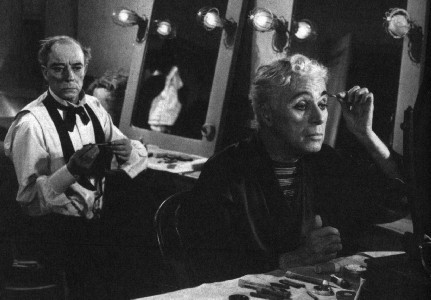
The draw of the movie is the last scene where Chaplin's character has one more shot at the big time. He enlists the aid of his old comic partner, a character played by Buster Keaton. Limelight will always be a historic movie of note as the only time the two titans of movies were in the same film (they once appeared in a minor publicity reel Seeing Stars in 1922).

Keaton and Chaplin were two of the three biggest and most innovative stars of the silent era (the third being Harold Lloyd). During their heydays, there was an active debate about who was the biggest, the funniest and the most influential. However, after the advent of sound their careers went in very different trajectories. Chaplin went onto even greater heights of success and freedom. After "The General" flopped, Keaton joined MGM. At MGM, Keaton lost control of his films, personal problems arose, he began to drink and his career went into a downward spiral.

By the time that Limelight was being made in the early fifties, Chaplin heard that Keaton was in financial straits due to a recent and disastrous divorce. Chaplin originally thought the part would be too small for Keaton, but eventually changed his mind. Despite the stories created by rival competitive fan bases, Keaton and Chaplin had always been friendly, and Chaplin was excited to have a Keaton on the set. Chaplin even loosened his strict directorial style to allow Keaton to have some free reign for improvisation.

I sat through the entire movie so I could watch these two together, hopefully a last gasp for their genius of an age gone by. Instead, I couldn't figure out if I was supposed to laugh or cringe. Their first scene together, backstage was mesmerizing. Chaplin's voice is high and slightly accented, Keaton's deep and full of character. There's an intimacy in watching these now old men go through the motions of getting ready for the stage, where they began their careers as children.

Then came their performance. I agonized through their stilted and static jokes. I couldn't figure out if the train wreck I was watching was intentional or if Chaplin's skill had deteriorated that badly. Plus, as the scene moved on, Chaplin began to ham it up to the camera and and audience. In early movies, such as City Lights and Modern Times, the classic Chaplin schtick worked. The last scene in Modern Times, Chaplin sings jibberish, but the hamming and act comes across brilliantly. Here the comedy and his actions seemed as desperate as the character he was playing.

A different stronger movie could have been made with these stars, even with these two characters. Instead of the focus being on Chaplin's odd relationship with Clair Bloom the movie would have focused on the dynamic and changes over the years of the comedic team. An early version of the Sunshine Boys, featuring two of the biggest stars the movies have ever created.

Instead, Keaton becomes overshadowed and underused as Chaplin relentlessly plays to the camera, trying desperately to forever be the Little Tramp to an audience that was no longer interested.

Since the release of Limelight, rumors have persisted that the movie was edited and re-cut to suit the desires of each fanbase. Keaton's fans believe that his best parts were cut out to so he wouldn't upstage Chaplin. Chaplin's people argue that he edited the film to enhance Keaton's performance. Neither notion is supported by much fact.

The truth is that the material isn't very good. The moment to maximize the talents of two aging genius comics coming to grips with changing times is completely squandered. Chaplin's own belief in his ability and material is ultimately the movie's undoing.

And because of Chaplin's decline I'm unable to dismiss Limelight. In fact, I'm fascinated. The movie has lingered in my thoughts. Chaplin's accomplishments and adeptness have few rivals; one of them is Buster Keaton. And Chaplin's success over such a large body of work is truly unprecedented. So, to watch a movie where not only his skills have diminished but to see him work through his insecurities and awareness of losing his audience make the movie entrancing.

Limelight was the last movie Chaplin made in the United States. After post-production, the McCarthy hearings forced him out of the country based on his supposed communist leanings and leftist politics. Limelight was officially released twenty years later in 1972, after America and it's politics had greatly changed and the score won Chaplin his only competitive Oscar. The movie also stars Claire Bloom, Nigel Bruce, the great character actor Norman Lloyd (no relation to Harold Lloyd) and an unprecedented amount of the Chaplin brood: Sydney, Geraldine, Josephine, Charles Jr., Michael and Oona.